
What to Expect Coaching Original Oratory
In Original Oratory, students deliver a self-written, 10-minute speech on a topic of their choosing. Competitors craft an argument using evidence, logic, and emotional appeals. Topics range widely and can be informative or persuasive in nature. The speech is delivered from memory. Scott Voss describes what it is like to coach the event.
What makes coaching Original Oratory unique?
Coaching Original Oratory is unique because it is so accessible. Most students have a frame of reference for persuasive speaking. They see examples on the news, and they study and write persuasive speeches in their communication classes. So students begin Oratory, more so than other events, at a different place. It’s also unique because the student gets to say exactly what they want to. They have free reign. They don’t have to search for the right piece to fit their message, and they are not restricted in what they say or how they say it. I’ll never forget talking to Keiaireyona Brown (2015) in her senior year. She had only been in speech for a year, but she had a story to tell. And Original Oratory was the best place for her to tell it.
How does competing in Original Oratory benefit your students?
Beyond the benefits Original Oratory shares with other public address events (like the development of skills in critical thinking, research, organization, and writing), it offers a heightened opportunity to craft messages and arguments with language. Original Oratory offers students the chance to learn important lessons about how to present difficult, sometimes hard to hear, messages in ways that can rise above the noise. I think of my student Mfaz Mohamed Ali (2024) who knew that she wanted to talk about Gaza at a time when it was pretty difficult to do so. People had firm beliefs about the topic, so Mfaz had to frame the message in a way that did not shut down the discussion, but nudged people to consider the situation differently. That’s a tremendous benefit to competing in Oratory. It teaches the craft of writing: wording, phrasing, and framing complex ideas. I think of her closing lines, “At the intersection of love and hurt. . . choose love.” Or Jihan Abdi’s (2022) line, “We might be in the same space, but we do not live in the same universe.” Or Halima Badri’s (2019) line, “America doesn’t just have a problem with hate; it has a problem with hurt.” In each of those cases, the orator learned the value of revising, crafting, and word playing until they could finally capture something memorable and significant in a single phrase.
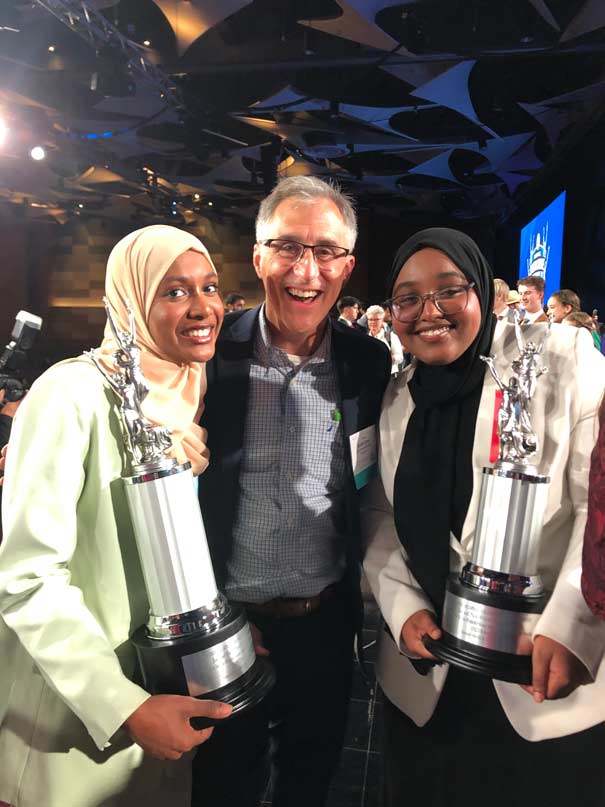
Mfaz Mohamed Ali, Scott Voss, and Jihan Abdi
Scott Voss is a teacher and three-diamond coach from Apple Valley High School in Minnesota. He is a long time-apprentice of Hall of Fame coaches Pam and Joe Wycoff, and has coached 11 NSDA national finalists in Original Oratory in the past 12 years.
Oratory, like all events, is a conversation. When a student chooses a thesis and shares it in rounds, they become a part of that conversation. Part of your job as a coach is to create space for them to add their voices to that conversation.
What do you most appreciate about coaching Original Oratory?
We aren’t just coaching speakers; we are coaching leaders. I was reminded of this recently here in Minnesota, when so many of our past and present orators used their voices to challenge, unite, comfort, and mobilize the community. I tell the orators that they have been given this gift. That people will turn to them in times of turmoil and chaos. That people will need someone to help them make meaning, to grieve, to resist, and to act. Taking on the mantle of Oratory comes with responsibility. Sounding pretty or having a way with words means little if you don’t really know who you are and what it is you stand for. Orators have to learn valuable lessons beyond just how to speak. They have to learn when to speak. They learn that “a word in season” is far more important than having a word every season. They learn that before you start speaking, you have to listen carefully and do your homework. And finally, they need to learn that, above all, they have to be authentic and real. I emphasize that they should not give an Oratory; they should live their Oratory. For me, I appreciate coaching Oratory because it is about cultivating the leaders who can help us navigate a difficult and uncertain future.
What should a new coach know about coaching Original Oratory?
First, meet students where they are. You might really love a thesis idea, but the student might not be ready for it. Or, perhaps they are really invested in a thesis idea that you know is overdone or not particularly strong for competition. While I certainly voice my concerns about their choices, I also know that this is their journey. Any competitive downsides of the thesis are offset by the interest and passion they have for it.
Second, remind students that Oratory is a speech, not an essay. Once we get to the writing phase, students will show up with a draft of a main point, and I’ll have them read it aloud. From that point on, we convert it from written text to a speech. I push them to make it more conversational or to employ more rhetorical choices, like using shorter sentences, inserting rhetorical questions, finding a catchy analogy, or using word play. Sometimes, I have students hit record while we talk through a passage because we don’t want to lose a cool phrase or thought we stumble across.
Finally, run group practices. If you don’t have enough orators, pull in students from Informative Speaking. Not only does it foster collaboration, but it also creates scholars of the event. For example, one of my students had written this really hard-hitting piece of analysis in her introduction and read it to the group. I loved it. One of the other orators commented on the fact that it was a pretty serious piece of evidence for the introduction and that it might be too soon in the speech for it. I told the student to keep it in the introduction because I liked it, but sure enough, a few weeks later a judge mentioned that the evidence was too heavy for the introduction. I should have listened to the scholar.
Oratory, like all events, is a conversation. When a student chooses a thesis and shares it in rounds, they become a part of that conversation. Part of your job as a coach is to create space for them to add their voices to that conversation, to craft messages that validate, challenge, and inspire audiences. Great coaches show students they have a seat at that table, they have something important to contribute, and they can have an impact on the world with the words they use.