
Showcasing Your Speech and Debate Skills
Speech and debate builds highly transferable skills that colleges and employers actively look for, such as advanced communication, research, analytical, and performance skills.
You may be asked to prepare a variety of materials when applying to a job, internship, or college, including personal essays, cover letters, scholarship applications, or statements of purpose. Each piece is an opportunity to demonstrate your abilities, experiences, and values. Use this guide when writing:
- College essays
- Scholarship applications
- Internship applications
- LinkedIn summaries
- Interview answers
This guide will help you translate your competitive experiences into clear, professional language that highlights your strengths and demonstrates real-world impact.
Sharing Your Story
Successful applications should move beyond listing activities and instead show how your experiences developed measurable skills, shaped your growth, and prepared you to contribute in new environments. Make sure all your materials work together to give reviewers a consistent, compelling picture of your character, skills, and potential. When your essays, applications, and letters reinforce the same story, your impact and readiness shine through.
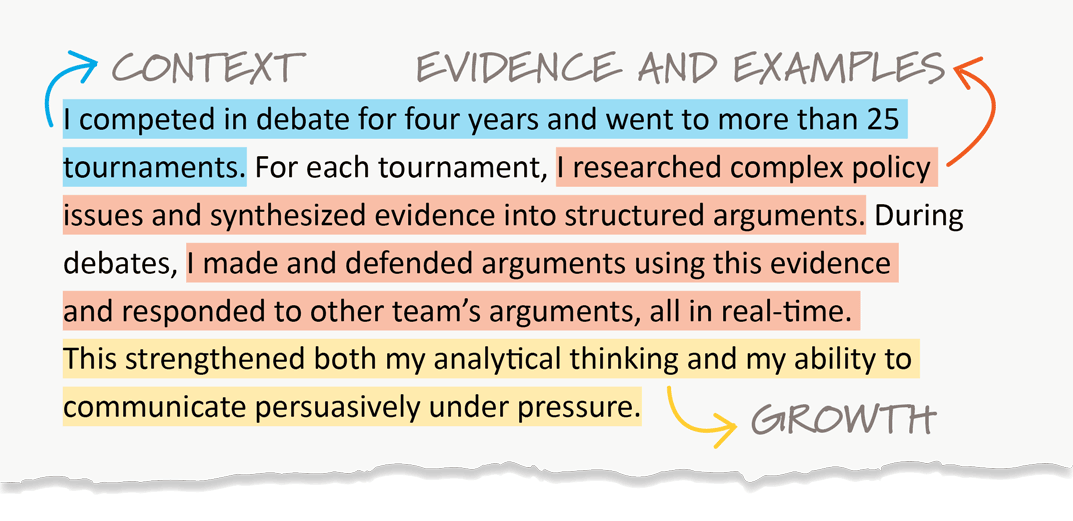
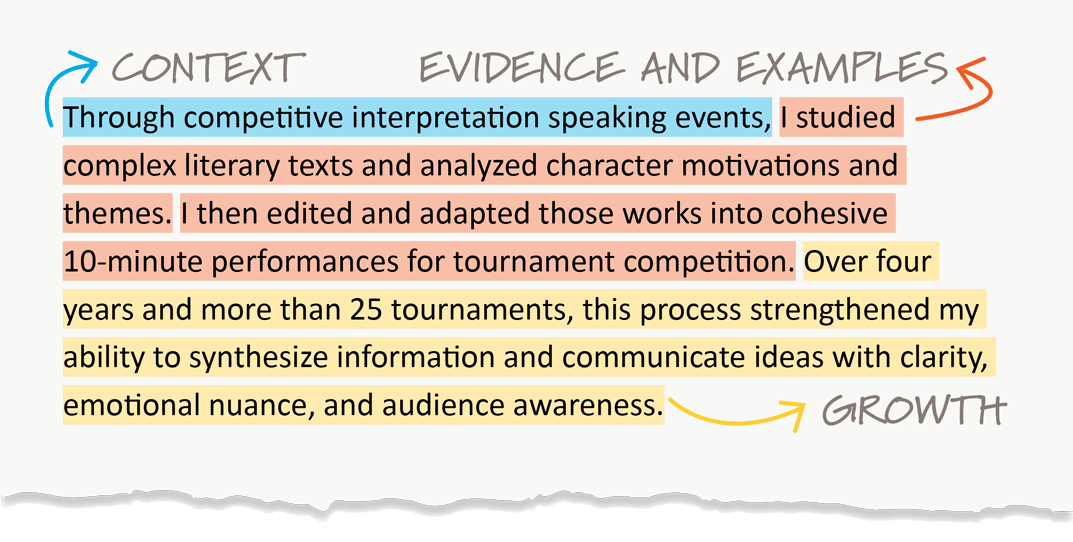
Follow this formula with specific examples of your experience:

For example:
Or:
Translating Speech and Debate for Broader Audiences
Colleges, scholarship reviewers, and employers may not be familiar with speech and debate terminology. Avoid insider language and event-specific jargon. Instead, describe what you did and the skills you developed in clear, approachable terms.
For example:
Instead of saying: “I used Unified Analysis for most of my extemp speeches.”
Say: “I regularly answered complex foreign policy questions by developing clear thesis statements supported by current, credible, and well-qualified sources.”
Common Speech and Debate Terms to Translate
Showcasing Your Skills
Below are skill areas you have likely developed through speech and debate, along with sample language to help you describe them clearly and confidently in your application materials.
These examples are meant to inspire and guide you. They do not need to, and should not, be copied word-for-word. You do not need to use all of them, and you should adapt the ideas to reflect your unique experiences, voice, and growth.
Think of these as starting points to help you articulate your individual strengths in a way that allows you to genuinely and confidently stand out.
|
Communication and Public Speaking
The ability to express ideas clearly and confidently is essential in every field, from classroom discussions to client presentations to leadership roles. |
Deliver prepared and extemporaneous speeches under strict time constraints. | “Presented research-based and performance-based material to diverse audiences in competitive settings.” |
| Adapt tone, pacing, and emphasis for different judges and audiences. | “Demonstrated advanced public speaking, storytelling, and audience engagement skills.” | |
| Bring complex literary texts to life through vocal and physical variation. | “Executed structured performances using intentional vocal and physical choices.” | |
| Structure and perform a cohesive ten-minute text with clarity and emotional impact. | ||
| Engage audiences through storytelling, a variety of characters, and compelling delivery. | ||
| Respond to live questioning or judge feedback with composure and precision. | ||
|
Critical Thinking and Analytical Reasoning
Strong analytical skills allow you to evaluate complex information, identify patterns, and make thoughtful, evidence-based decisions in academic, professional, and everyday settings. |
Research complex policy, social, and philosophical topics from multiple perspectives. | “Conducted independent research and synthesized findings into structured arguments and performances.” |
| Closely analyze literature for theme, character motivation, tone, and subtext. | “Applied advanced analytical reasoning to both argumentative and literary texts.” | |
| Cut and rearrange scripts to create a clear narrative arc within a ten-minute time limit. | “Edited and structured material strategically to maximize clarity and impact.” | |
| Evaluate source credibility and identify weak reasoning. | ||
| Synthesize large volumes of research or text into cohesive arguments or performances. | ||
| Make strategic decisions about pacing, blocking, and emphasis to strengthen impact. | ||
|
Performance Under Pressure
The capacity to think clearly and deliver results in high-stakes situations builds resilience and reliability. All qualities valued in exams, interviews, and workplace challenges alike. |
Compete in elimination rounds requiring rapid adjustment. | “Exhibited composure and strategic thinking in high-pressure environments.” |
| Maintain composure during cross-examination or emotionally demanding performances. | “Delivered structured presentations and performances under strict time limits.” | |
| Adapt blocking, timing, or delivery based on audience response. | “Adapted quickly to live feedback in competitive settings.” | |
| Balance technical precision with authentic emotional expression. | ||
| Deliver polished performances under strict time constraints. | ||
|
Leadership and Mentorship
Guiding others, setting a vision, and supporting team growth demonstrate initiative and interpersonal strength that translate directly to campus involvement and professional advancement. |
Mentor new team members in case construction, cutting scripts, or blocking performances. | “Mentored peers in research, performance preparation, and public speaking.” |
| Review teammates’ speeches and interpretation pieces, offering constructive feedback. | “Led collaborative training sessions and provided structured peer feedback.” | |
| Model professionalism, accountability, and preparation standards. | “Contributed to a positive and inclusive team culture.” | |
| Foster an inclusive and supportive team environment. | ||
| Lead practice drills, warm-ups, or character workshops. | ||
|
Initiative and Intellectual Independence
Taking ownership of your learning and pursuing ideas proactively signals curiosity, self-motivation, and the ability to thrive without constant supervision. |
Select and curate interpretation pieces that reflect personal curiosity and depth. | “Designed and developed original presentations and performance pieces.” |
| Experiment with unconventional topics or performance styles. | “Demonstrated initiative through self-directed research and creative adaptation.” | |
| Conduct independent research beyond required practice. | “Independently structured material to meet competitive standards.” | |
| Take initiative to revise scripts, blocking, and delivery without prompting. | ||
| Develop original speeches or unique argumentative strategies. | ||
|
Time Management and Discipline
Balancing rigorous preparation, competition schedules, and academics reflects strong organizational habits that are critical for success in college and career environments. |
Balance tournament travel and rehearsals with coursework and extracurriculars. | “Balanced rigorous academic coursework with competitive preparation.” |
| Rehearse extensively to refine timing, blocking, and transitions. | “Demonstrated strong organizational skills through long-term performance planning.” | |
| Maintain preparation schedules during academically demanding periods. | “Managed multiple deadlines in fast-paced environments.” | |
| Compete in multiple events simultaneously. | ||
| Manage weekly research, memorization, and revision deadlines. | ||
|
Information Literacy and Research Skills
Knowing how to locate, evaluate, and synthesize credible sources equips you to navigate today’s information landscape with discernment and integrity. |
Analyze academic journals, literature, policy briefs, and diverse media sources. | “Conducted comprehensive research using diverse and credible sources.” |
| Distinguish between strong and weak evidence. | “Applied critical evaluation to assess evidence and textual strength.” | |
| Structure arguments and performances around credible research and intentional textual analysis. | “Synthesized research and literature into cohesive presentations.” | |
| Compare multiple sources to build cohesive narratives or cases. | ||
| Select interpretation material based on thematic depth and relevance. | ||
|
Conflict Navigation and Professionalism
Engaging respectfully with opposing viewpoints builds emotional intelligence and the ability to collaborate effectively with everyone you go to school with or work with. |
Engage in rigorous but respectful debate with opposing competitors. | “Engaged in structured intellectual disagreement while maintaining professionalism.” |
| Accept public written feedback constructively. | “Demonstrated respectful communication in competitive environments.” | |
| Portray complex characters and controversial themes with thoughtfulness and respect. | “Applied feedback constructively to improve performance.” | |
| Maintain professionalism in competitive settings. | ||
| Model sportsmanship in wins and losses. | ||
|
Growth Mindset and Coachability
Welcoming feedback and continuously refining your skills demonstrates adaptability, a trait that fuels long-term success in both academic and professional spaces. |
Use judge ballots to revise arguments, scripts, and blocking. | “Applied structured feedback to refine analytical and performance skills.” |
| Rework pieces multiple times to improve clarity and emotional arc. | “Demonstrated resilience through iterative improvement.” | |
| Track progress across seasons and tournaments. | “Proactively sought critique to enhance performance outcomes.” | |
| Seek out critique to strengthen delivery and analysis. | ||
| Embrace challenging material or events to grow beyond comfort zones. | ||
|
Cultural Awareness and Perspective-Taking
Understanding diverse viewpoints fosters empathy and global awareness, preparing you to contribute meaningfully in increasingly interconnected communities. |
Argue positions different from personal beliefs. | “Demonstrated ability to analyze and present diverse perspectives.” |
| Perform literature representing diverse voices and lived experiences. | “Engaged thoughtfully with complex social and cultural themes.” | |
| Analyze social and global issues through multiple lenses. | “Communicated nuanced viewpoints with clarity and empathy.” | |
| Approach sensitive topics with nuance and care. | ||
| Balance advocacy with integrity and empathy. |
Requesting Letters of Recommendation
What Is a Letter of Recommendation?
A letter of recommendation is a way for someone who knows you well (such as a teacher, speech and debate coach, mentor, or supervisor) to share your character, work ethic, and accomplishments with colleges, scholarship committees, or other programs. These letters give readers a sense of who you are beyond grades, test scores, trophies, and transcripts. By the end of the letter, the reader should have a clear picture of your strengths and growth.
Letters of recommendation are often required for college or scholarship applications, and unlike other parts of your application, you don’t write or edit them yourself. Instead, you ask a trusted adult who can speak authentically about your skills and experiences to write the letter on your behalf. Usually, the recommender sends it directly to the school or program, so you don’t see it.
How Do I Request a Letter of Recommendation?
Choose Recommenders Carefully
Pick recommenders who know you well and can share specific examples of your skills and growth. Choose people who understand your strengths and can explain them clearly. Recommenders should be professional relationships—no family members or friends.
Ask Thoughtfully
Reach out four to six weeks before the earliest deadline to show respect for their time. Share what you’ve learned from them, how they’ve seen you grow, or why their perspective matters. This helps them understand why their letter will be meaningful.
Provide Complete Information
Share everything they might need to write a strong letter. This typically includes:
- Information about you:
- Your resume or activities list.
- Context about your goals and priorities—for example, the programs you’re applying to, your intended major, and why they’re important to you.
- Key traits or characteristics you’d like emphasized, such as leadership, resilience, critical thinking, collaboration, or intellectual curiosity.
- Specific anecdotes or achievements that illustrate your skills and contributions, especially ones your recommender may not remember in detail.
- Your resume or activities list.
- Where and how they should submit the letter(s), such as forms, links, app, website, school portal, email, etc.
- Exact deadline(s)
Give Them an Easy Out
A strong recommendation comes from someone who feels confident and has the time to write it thoughtfully. Give your potential recommender a clear, respectful way to decline by framing your email as an invitation, not an obligation.
Recommendation Letter Request Email Template
Subject: Recommendation Letter Request
Dear [NAME],
I’m reaching out to ask if you would consider writing a letter of recommendation for me to support my application [to COLLEGE / for SCHOLARSHIP].
You have seen my growth and work as a student and competitor and I truly value the mentorship and support you’ve provided along the way. Your perspective on my development would mean a great deal to me because… < Why you are asking this person to write for you>
I am applying [to COLLEGE / for SCHOLARSHIP] because [LIST YOUR GOALS].
I’m a good fit because [DESCRIBE YOUR SKILLS, TRAITS, EXPERIENCE, ACHIEVEMENTS].
I have also attached my resume and list of activities. Please let me know if you need any more information.
I would be honored if you’d consider writing a letter of recommendation for me. It is due by [DATE] and must be submitted by [METHOD].
I completely understand if your schedule doesn’t allow for it, and I appreciate you taking the time to consider my request.
Warmly,
[YOUR NAME]
| If the Requester Says “No” | If the Requester Says “Yes” |
|---|---|
|
Sometimes, a potential recommender may decline because of time constraints, workload, or other reasons. This is normal and not a reflection on you or your abilities. Respond professionally and express gratitude for their time. You might say something like, “Thank you so much for considering it. I completely understand, and I really appreciate your support in other ways.” |
Say Thank You Right Away Check In Send a Final Thank You Note After letters are submitted, or at the end of the application season, send a thank-you note. Let them know where you decide to attend. |