
Mental Health Strategies
Mindfulness and Self-Care
Speech and debate is an intellectually and physically demanding activity. To perform your best, and sustain that performance over a long season, you need a foundation of well-being.
Mental wellness is built through consistent habits rather than one-time fixes. By prioritizing sleep, nutrition, and recovery, you build strategic routines to ensure your mind and body feel prepared and capable.
The following guide breaks down how to prioritize your wellness at every stage of the tournament experience.
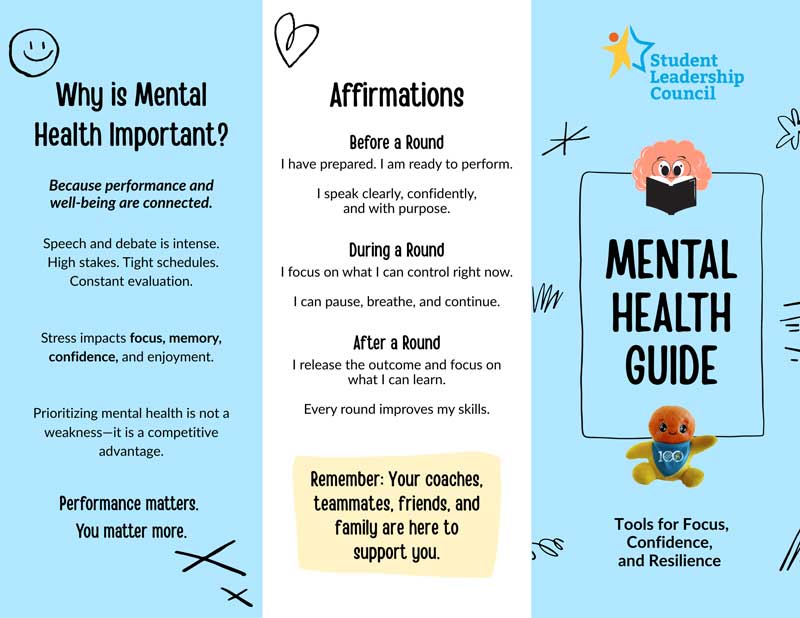
Mental Health Guide
This pamphlet provides a quick guide to recognizing challenges, taking care of your own mental health, and supporting friends or teammates. Download and share it with anyone who may benefit!
The Night Before
What you do the night before a tournament directly impacts your regulation and focus the next day.
Reduce Decision Fatigue
We have a limited amount of mental energy for making decisions each day. Do not waste that energy on small choices the morning of a big tournament.
-
- Lay it out: Set out your competition attire, shoes, and grooming supplies.
- Pack the essentials: Ensure your bag is packed with competition materials, chargers, water, and comfort items.
When you wake up knowing everything is ready, you start the day in a state of calm rather than a state of reactive stress.
Clear Your Mind
Anxiety often keeps us awake because our brains are trying to “hold on” to information so we don’t forget it.
-
- “Brain Dump”: If your mind is racing, write down every worry, argument, or task on a piece of paper.
Getting thoughts out of your head and onto paper signals to your brain that the information is safe, allowing you to transition into sleep mode.
Prioritize Sleep
Sleep is when your brain consolidates memory and regulates emotion.
-
- Disconnect: Step away from social media and resist the urge to make last-minute edits to your speeches.
- Prioritize sleep: Aim for 8+ hours. A well-rested brain has faster reaction times and better emotional control in high-pressure rounds.
The Morning Of
Morning Check-In
Tournament mornings are often rushed, loud, and overstimulating. Before you enter the school or log in, take two minutes to calibrate. Ask yourself:
-
- How am I feeling physically?
- How am I feeling mentally?
- Is there anything I need right now?
Use what you notice to guide one small next step. If you feel physically drained, grab a quick snack or water. If your mind feels scattered, try a brief grounding or breathing exercise.
Reframe the Nerves
Anxiety and excitement feel very similar in the body (rapid heart rate, butterflies).
Instead of saying, “I am so nervous,” try saying, “I am excited for this challenge.”
This process is called “arousal reappraisal.” It helps you view your physical energy as a performance asset rather than a threat.
Fueling Your Body
Nerves trigger the “fight or flight” response, which often suppresses digestion and appetite. However, your brain burns a significant amount of energy during competition.
-
- Start with something: Try to eat something in the morning to jump-start your metabolism, even if it is small.
- Avoid the crash: Sugary snacks provide a quick spike but a hard crash. If available, prioritize carbs and proteins that provide slow-burning energy.
- Proactively hydrate: Dehydration significantly impacts focus and can cause headaches that mimic anxiety. Sip water consistently, even if you don’t feel thirsty.
Note: If nausea frequently prevents you from eating, please talk to a coach or trusted adult about strategies to manage pre-round nerves.
During the Tournament
Before a Round
Find a technique that helps you focus on the present moment:
-
- Use a brief grounding exercise (refer to Quick Calm Tools)
- Repeat a short affirmation (refer to Affirmations)
- Reflect on your goals for the round (refer to Reflection and Growth Tools)
- Listen to uplifting music (refer to Music and Mood)
Tournaments are social, but they can also be draining:
-
- Manage “Stress Contagion”: Panic is contagious. If a group is spiraling or obsessing over brackets, it is good to step away.
- Find your quiet: Identify a hallway or corner where you can decompress for five minutes if the noise becomes overwhelming.
During a Round
Once the round begins, your goal is to stay anchored in execution rather than evaluation. Focus on what you can control in the moment, and avoid unnecessary self-disruption.
-
- Avoid comparison: Hearing other competitors before you can trigger self-doubt. Differences in delivery or confidence do not require you to change your own approach mid-round.
- Stick with your preparation: Last-minute overcorrections often increase stress and reduce clarity. Trust the structure, pacing, and strategy you practiced.
- Let small mistakes go: A dropped word or imperfect response is normal. Mentally releasing minor errors helps you stay present for what comes next.
When you are not actively speaking, how you use waiting time matters. Unstructured downtime can increase anxiety if it turns into overthinking.
-
- Listen with purpose: Pay attention to what is relevant to your next contribution instead of rehearsing everything at once.
- Narrow your focus if you feel overwhelmed: Direct your attention to the next actionable task—your next question, response, or speech segment.
- Mentally reset between speaking moments: Each time you sit down is a chance to release the previous performance and re-enter the round focused on the next step.
After a Round
It’s tempting to replay every moment in your head. This can quickly become exhausting. Instead:
-
- Physically reset: Drink water, stretch, or move around for a minute.
- Socially reset: Chat with teammates about something other than the round.
- Mentally reset: Give yourself two minutes to vent or think about what went wrong in the last round. Once the time is up, physically shake it off and move on.
Each round is a new opportunity to apply what you learned and show up stronger than before.
After the Tournament
Mental health doesn’t end when the tournament does. Burnout happens when there is no recovery period.
Rest
After 12+ hours of high adrenaline and focus, your body will crash.
You may feel low-mood the day after the tournament. Recognize this as physical recovery, not a sign that something is wrong.
Active Recovery
-
- Reflect intentionally: Write down one specific growth point and one success. Close the book on the tournament so you don’t carry the stress into the school week.
- Unplug: Your brain needs a break from processing arguments. Engage in a hobby that is low-stakes and unrelated to speech and debate.
When to Reach Out for Support
Speech and debate should challenge you, but it should never harm you. It is time to ask for support if you notice patterns like:
-
- Pre-tournament nerves escalating into panic attacks or illness.
- Dread replacing enjoyment for significant periods.
- Difficulty sleeping or eating that lasts beyond the tournament weekend.
Please talk to someone—a coach, trusted adult, school counselor, or mental health professional. Asking for help is a sign of high self-awareness and strength.
Quick Tools for Staying Calm
Speech and debate is fast-paced and energizing, and moments of anticipation are a normal part of competition, especially right before a round begins. When you have 30 to 120 seconds, you don’t need a big reset, just something quick and practical.
Intentional breathing and grounding techniques can help you steady your body, sharpen your focus, and enter the round prepared. These tools are designed for short, high-energy moments when you want to feel present and confident.
Which Tool Should I Use?
| If you feel… | Use this tool… | Why? |
|---|---|---|
| Heart Racing | 4-7-8 Breathing | Settle your body and regain control. |
| Distracted or Jittery | Box Breathing | Create a steady rhythm for focus. |
| Overwhelmed or Stuck in Your Head | 3-3-3 Rule | Refocus on the present moment. |
| Restless or Fidgety | Feet Grounding | Release energy quietly. |
| Anxious While Waiting | Fidget Object | Stay relaxed between rounds. |
4-7-8 Breathing
Best for: steadying yourself and increasing focus without feeling drowsy.
When to Use
-
- Right before entering the competition room
- Immediately after learning your room assignment
- After a rough round when adrenaline is high
How it Helps
This breathing pattern activates your body’s natural calming response, helping slow a racing heart and reduce physical adrenaline so you can speak comfortably.
How to Do It
-
- Inhale through your nose for 4 seconds
- Hold your breath for 7 seconds
- Exhale slowly through your mouth for 8 seconds
Follow-along video: 4-7-8 Breathing Exercise
Box Breathing (Square Breathing)
Best for: steadying yourself and increasing focus without feeling drowsy.
When to Use
-
- Sitting outside the room
- During your prep time
- Right before you speak
How it Helps
Box breathing gives your breathing a predictable structure, which helps organize your thoughts and maintain consistent pacing while you speak.
How to Do It
-
- Inhale for 4 seconds
- Hold for 4 seconds
- Exhale for 4 seconds
- Hold for 4 seconds
Follow-along video: Box Breathing Technique
3-3-3 Grounding Rule
Best for: racing thoughts, feeling overwhelmed, or difficulty staying present.
When to Use
-
- When your thoughts are racing
- When you feel shaky or disconnected
- When you’re stuck replaying past rounds or worrying about outcomes
How it Helps
This technique pulls your attention out of your head and back into the present moment by engaging your physical senses.
How to Do It
-
- See: name three objects you can see in the room
- Hear: name three sounds you can hear
- Move: move three parts of your body (e.g., wiggle your fingers, roll your shoulders, tap your toes)
Feet / Toe Grounding
Best for: managing restless, “jittery” energy when you can’t sit still.
When to Use
-
- Sitting in a hallway
- In the room before you speak
- While listening to other competitors
How it Helps
Engaging your feet provides a stable physical anchor, allowing nervous energy to release through your body without being distracting to others.
How to Do It
-
- Place both feet flat on the floor and notice the pressure
- Slowly lift your toes, spread them wide, then place them back down
- Gently press your heels into the floor, then release
Repeat for 20-30 seconds
Discreet Fidget Object
Best for: releasing nervous energy quietly and subtly.
When to Use
-
- While waiting for your next round to begin
- Sitting outside competition rooms
- Between rounds
How it Helps
Small, repetitive movements provide an outlet for restlessness, making it easier to wait, listen, and stay composed between rounds.
How to Do It
- Use a small, quiet object (like a spinner ring, a smooth stone, or a coin)
- Keep your movements repetitive and subtle
- Ensure the object is something you can use without looking at it, so you can stay engaged with your surroundings
With practice and consistent use, these tools can support focus and confidence, making it easier to stay engaged and present throughout a tournament.
Affirmations
Affirmations are positive, present-tense statements that help challenge unhelpful or negative thoughts and build resilience. Research shows that affirmations can activate areas of the brain related to self-processing and reward, helping people maintain a positive self-view even under stress.
When practiced consistently, affirmations can strengthen neural pathways linked to confidence, focus, and emotional regulation.
How to Practice Affirmations
Affirmations are most effective when they are repeated regularly and paired with routine. Here are a few ways to build them into your routine:
-
- Mirror work: While brushing your teeth or washing your hands, look at yourself in the mirror and say an affirmation out loud. Hearing your own voice while making eye contact makes the message feel more real and grounded.
- Written affirmations: Write one or two affirmations in a journal each morning or evening. The act of writing helps slow your thinking and reinforces the message more deeply than just thinking it..
- Visual cues: Place a sticky note on your mirror, water bottle, or inside your notebook. Seeing the words repeatedly helps normalize supportive self-talk.
- Tournament reset: Use affirmations quietly in the restroom, hallway, or prep room. Even a single sentence can help you “reset” your mindset between tough rounds.
When to Use Affirmations
Daily Routine
-
- Morning: Set the tone for the day and build confidence before stress appears.
- Before bed: Release self-criticism and mentally close the day.
How it Helps
-
- Before your first round: Ground yourself and focus on preparation rather than outcomes.
- Between rounds: Reset after a tough round or refocus before the next one.
- During breaks: Use mirror work or quiet repetition to steady nerves.
Moments of Doubt
-
- Anytime negative self-talk shows up, pause and repeat an affirmation tied to your values, such as growth, curiosity, or resilience.
Specific Affirmations for Speech and Debate
Pick a few that feel meaningful to you. You don’t need to use them all, just the ones that resonate.
Before a Round
-
- I have prepared, and I am ready to perform.
- I will go into this round and give it my best effort, regardless of the outcome.
- I can speak clearly, confidently, and with purpose.
- I don’t need to be perfect to be effective.
During the Round / Facing Nerves
-
- I am focusing on what I can control right now.
- One sentence at a time.
- I can pause, breathe, and continue.
- I trust myself to think and respond in the moment.
After a Round
-
- I release the outcome and focus on what I can learn.
- One round does not define my worth or my talent.
- Every round makes me a stronger competitor.
- I can be proud of myself regardless of the result.
Video Guides for Affirmations
If you prefer to follow along with a guide, these short videos are excellent for structured practice:
For Confidence: Daily Affirmations for Self-Esteem – best for morning routines
For Stress Relief: Affirmations for Peace and Calm – best for cooling down after a high-stress day
Music and Mood
Music can be a powerful way to regulate focus, energy, and emotions at tournaments. Whether you need to reset between rounds, block out a crowded prep room, or shift into the right mindset before speaking, the right playlist can make all the difference.
Anchoring Your Mindset
One approach that works especially well is choosing music tied to a positive memory or familiar feeling. Closing your eyes and focusing on the melody, rhythm, or lyrics allows you to mentally get away from the high-pressure environment and ground yourself before you compete.
It can also be helpful to invest in a pair of headphones and bring them to every tournament. Headphones allow you to block out noise, reduce sensory overload, and create space to sit with your own thoughts when needed.
Below are a few playlist styles competitors commonly use. We also included some recommendations from members of the NSDA Student Leadership Council!
Calm and Grounded
Best for: slowing your breathing, settling nerves, and emotionally resetting.
Use This If You Feel:
-
- Overstimulated or anxious
- Emotionally drained
- Like your thoughts are racing
Styles to Consider
-
- Acoustic or stripped-down tracks
- Classical piano or instrumental music
- Ambient lo-fi
- Indie
SLC Favorites
-
- Classical piano
- Frank Ocean
- Giveon
- Tame Impala
Energy and Confidence Boost
Best for: getting out of your head and into performance mode.
Use This If You Feel:
-
- Flat or low-energy
- Self-doubting
- Stuck overthinking before a round
Styles to Consider
-
- High-energy pop
- Hip-hop
- Musical theater songs tied to confidence
- Songs that make you want to move
SLC Favorites
-
- Don’t Smile – Sabrina Carpenter
- Lose Yourself – Eminem
- My Shot – Hamilton
- Bad Romance – Lady Gaga
- Viva La Vida – Coldplay
Locked In
Best for: prepping, writing cases, or mentally centering before speaking.
Use This If You Feel:
-
- Sustained concentration
- Something to block out noise in prep rooms
- Mental clarity without high emotional intensity
Styles to Consider
-
- Instrumental soundtracks
- Lo-fi study beats
- Songs in a language you don’t speak (to avoid distracting lyrics)
SLC Favorites
-
- Guided meditation or focus tracks
- Headspace sessions
- Instrumental music paired with noise-canceling headphones
Champion Perspectives

How do NSDA champions and leaders handle the stress of high-stakes rounds? We asked national champions and members of the Student Leadership Council (SLC) to share the specific habits and mindsets they use to stay grounded.
Advice from National Champions
The “Toe Piano” Method
One of the things that my coach taught me was to ‘play piano’ with your toes before a round. Nobody can see your toes moving inside your shoes. Rather than fidgeting with your hands—which the judges can see—it’s a way to calm down while keeping the movement concealed. It keeps your mind off the nerves and the pressure.
How to Use It (One-Minute Reset):
-
- Sit or stand with both feet flat on the floor.
- Inside your shoes, tap your toes in a rhythmic pattern like you’re playing a piano.
- Continue for 20-30 seconds.
- Keep your hands still and relaxed.
- Focus entirely on the sensation in your feet to pull your mind away from anxious thoughts.
The “Zoom Out” Strategy
Nationals can feel like the end of the world, but it’s really not. That week is just one week out of the year. When you look at things in a larger context, it gets a lot easier to breathe. If you look at 20 bills to prep, it’s overwhelming. But if you take it one bill at a time, it’s manageable. Don’t put too much stress on yourself—there will always be other tournaments.
How to Use It:
-
- Put it in context: Remind yourself that this tournament is a small part of your year.
- Break it down: Focus on one bill, one round, or one speech at a time.
- Release perfection: Give yourself permission to be human. One round does not define your talent.
The “No Restart” Rule
When anxiety hits, I stop thinking about the whole speech and stay connected to what I’m saying in the moment. I don’t try to get ahead of myself. If I make a mistake or blank, I don’t stop. I keep going and let the next words come. Recovery is part of the skill.
How to Use It:
-
- When nerves spike, focus fully on the sentence you are currently saying, not the rest of the speech.
- Deliver that sentence cleanly before thinking about what comes next.
- If you stumble or forget a line, try to keep speaking instead of freezing or apologizing.
- Maintain steady pacing and eye contact while your thoughts realign.
- Practice this by finishing your speech in practice runs, even after mistakes, so continuing feels natural in-round.
Strategies from the Student Leadership Council
Everyone manages nerves differently. Whether you need to move your body, distract your brain, or find a fresh perspective, here is how SLC members stay focused and mentally healthy during long tournament days.
Mental Focus and Control
One of my best techniques is focusing only on what I can control. I lock in on my prep rather than stressing about pairings or how good the other team is.
I love to play a simple puzzle game on my phone. It keeps my mind distracted from the stress of the round, but also keeps it active enough that I’m ready to start prepping the second it’s my turn.
I keep my left hand in my pocket. Having one or two small habits can make a stressful or monumental round a little less intimidating.
Movement and Physical Grounding
Just a quick round of ‘razzle dazzle’ and shakes always gets my body moving and gets me out of my head. I also keep a plushie duck next to me as I prep, which I can hold if I start to get nervous.
If it’s an online round, I’ll do a K-pop dance to get the nerves out. In person, I repeat a mantra in my head to remind me why I started, like: ‘I am a storyteller. I am an advocate.’
After rounds, I drink some water and go outside for a few minutes to walk around. Seeing the sun and grounding myself helps me refresh before jumping into the next task.
Connection and Perspective
I try to socialize with novices and younger teammates to take my focus off of my competition anxiety and onto theirs. Sometimes, it even helps to work on schoolwork; it reminds me that this one round or tournament doesn’t define me as a person.
Our team has a speech and debate plushie that we take with us to tournaments. We give it hugs throughout the day when needed. Having a physical object for reassurance can be incredibly comforting.
I try to talk to people from other schools before rounds, even if it is just small talk while we are waiting outside the room. It humanizes everyone. My competitors stop feeling like intimidating opponents and start feeling like students who care about this activity just as much as I do. Remembering that we are all here because we love speech and debate takes a lot of the pressure off.
Finding Your Center
As these leaders show, there is no single “right” way to handle nerves. Some competitors need movement, while others need quiet distraction or social connection.
Mental wellness in speech and debate takes practice. It’s okay to test out different strategies across rounds and tournaments to see what works best for you. Above all, remember that you are more than a single ballot, round, or result.
Reflection and Growth
Reflection is one of the most powerful tools in speech and debate. It helps you understand yourself as a competitor and allows you to track your development over time.
Reflection does not have to mean writing in a notebook every time. It can be:
-
- journaling or taking quick notes
- talking with a teammate, coach, friend, or parent
- recording a quick voice note or video to yourself
- mentally checking in with yourself
What matters is that you give yourself space to process each experience rather than just moving on to the next task.
Why Reflection Matters
Speech and debate are built on repetition; reflection is how you ensure that repetition leads to improvement. It helps you:
-
- recognize growth that might not show up on a ballot
- separate your self-worth from your competitive performance
- identify the specific habits that lead to better results
- reconnect with why you chose this activity
Even on the toughest days, showing up and competing builds confidence, adaptability, communication, and resilience. These are skills that last long after the tournament ends.
Before a Round: Intentional Focus
Entering a round with a clear purpose helps replace anxiety with focus.
For Speech:
Choose one specific goal to manage your focus:
-
-
-
-
-
-
- “I want to focus on my pacing today.”
- “I want to prioritize eye contact with the judge.”
-
-
-
-
-
Keep it to one goal so your focus stays manageable.
For Debate:
-
-
-
- Identify the three key arguments you want to emphasize.
- Consider how to adapt your strategy to the judge or room.
- Ask: “What does success look like for me in this round, regardless of outcome?”
-
-
This kind of reflection helps you enter the round with purpose rather than anxiety.
After a Round: Learning Without Self-Criticism
After a round, emotions can run high. Use this “Keep/Change” structure to stay objective:
For Speech:
Name three things that went well. Then ask yourself:
Keep: What was successful that I should continue doing?
Change: What specific part needs more practice?
Then: List one thing you learned from this round that you can apply next time.
For Debate:
Name three things that went well. Then ask yourself:
What specific ideas or arguments did you and the judge differ on?
Was this about strategy, clarity, weighing, or something else?
Then: List three areas for improvement based on your skills rather than the ballot.
After a Tournament: Perspective and Celebration
Take a moment to zoom out and reflect on the bigger picture of your weekend:
-
-
-
- What am I proud of from this tournament?
- How did I show resilience or courage when things got difficult?
- What did I learn about myself as a competitor?
-
-
Make space to celebrate:
-
-
-
- You showed up.
- You competed.
- You practiced a difficult skill in a high-pressure environment.
-
-
Your effort matters, regardless of results.
Your effort matters, regardless of results.
Reflecting on Your “Why”
If you ever feel disconnected from the activity, ask yourself why you started.
-
- What skills are you building?
- What keeps you coming back?
Your “why” might change over time, and reflecting on it helps you stay intentional, honest, and motivated.