
What to Expect Coaching Duo Interpretation
In Duo Interpretation, competitors team up to deliver a 10-minute performance of a published play or story. Using offstage focus, competitors convey emotion and environment through a variety of performance techniques focusing on the relationships and interactions between the characters. No props or costumes are used. Performances can also include an introduction written by the students to contextualize the performance and state the title and the author. Ethan Gambriel describes what it is like to coach the event.
What makes coaching Duo Interpretation unique?
Duo Interpretation allows for endless creativity from the first moment. Most events have a purpose like being funny, informative, persuasive, or dramatic; Duo allows students to explore each of these skills simultaneously. It combines the technique of Humorous Interpretation in characterization, the acting and visualizing skills of Dramatic Interpretation, the blocking and choreography of a Program Oral Interpretation, and the interpersonal skills of a partner debate event! This conglomeration of events is perhaps what makes Duo so special to me, because it allows me to experiment with styles and techniques that suit our students. Duo Interpretation is never one-size-fits-all, and this is proven time and time again in competition. Watch the final stage for one year, and you’ll see six different techniques, six different styles, six different types of scripts, and six powerful stories. Coaching Duo is about helping students discover how they communicate best, then building a piece that honors that voice.
How does competing in Duo Interpretation benefit your students?
Duo is a great way to teach students strong listening. Sometimes I find that performers are trapped in reading their lines as if they are an essay, with no real motivation or direction. In Duo, however, they hear another human speak and have to REACT! Teaching them to act and react with one another is a great way to help them in every aspect of their life. We all know that speech is not only about speaking, but about listening with intention as well. In Duo, the act-and-react process helps them build skills like authenticity, presence, and trust.
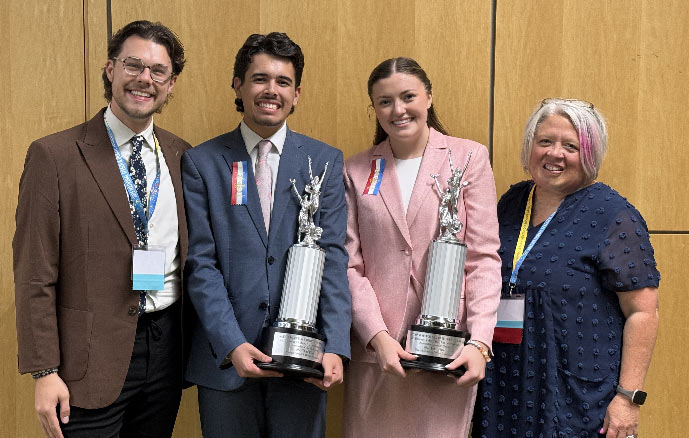
Ethan Gambriel, Kaeden Abraham, Isabella Windmiller, and Kathy Tobin
Ethan Gambriel teaches and coaches speech and debate at Willard High School. Coach Gambriel was the 2019 NSDA Nationals Duo Interpretation runner up and coach of the 2025 NSDA Nationals Duo Interpretation third place team. Coach Gambriel advocates for Duo Interpretation as the event that has changed his life as a performer and coach, and continues to shape his students’ lives far beyond high school.
Coaching Duo is about helping students discover how they communicate best, then building a piece that honors that voice… When performers are seen and supported, their voices stand out.
Not only does this help their general performance skills, but the unique features of the event, like off-stage focus, open up a world of possibilities for blocking and choreography. We can create incredible shapes and movement to communicate with our bodies in ways that we normally would not. This pushes students’ imagination, collaboration, and creative problem-solving skills, which is something I am always looking for as a coach. When my students tell me, “We don’t know how to block this,” I always say we should try every single potentially viable option, because something will always stick! These skills will follow these students for the rest of their lives.
What do you most appreciate about coaching Duo Interpretation?
Duo provides room at the table for anyone to be successful. It doesn’t matter if you are at a small rural school or a bustling metropolitan district, because this event is different at every single school and every single performance! Each Duo performance is a slightly different style of technique, script choice, and content. There are pieces with two characters who never change and pieces with up to 10 characters that are constantly changing. There are Duos that are strictly comedic, and some that are strictly dramatic. Being able to blend techniques from other events like Humorous Interpretation or Dramatic Interpretation creates an environment where I get to explore what styles and techniques work the best for which students. Duo is like a playground, and you get to create all of the equipment that your performers use.
Not only does this help their general performance skills, but the unique features of the event, like off-stage focus, open up a world of possibilities for blocking and choreography. We can create incredible shapes and movement to communicate with our bodies in ways that we normally would not. This pushes students’ imagination, collaboration, and creative problem-solving skills, which is something I am always looking for as a coach. When my students tell me, “We don’t know how to block this,” I always say we should try every single potentially viable option, because something will always stick! These skills will follow these students for the rest of their lives.
What should a new coach know about coaching Duo Interpretation?
Duo Interpretation can feel a bit overwhelming at first since the event has so many options. Yet, I encourage all new coaches to share this event with their team. Students love performing with their best friends, and as a coach, I love working with them as a team. It is a very collaborative process! When you start, keep it simple. When you see blocking and choreography on the final stage, you are experiencing the result of students who have been tweaking, refining, and practicing for a full school year. The details are immaculate, but they probably didn’t start there. Students might get stuck at the beginning because they are expecting their piece to be a polished national finalist at the first practice…That will never be the case! I often encourage students to start basic so we have something to build off of. No one starts the season as a national champion, but anyone can work their way to that point. Most importantly, play to your performers’ strengths. The goal of a Duo piece is not to chase what “wins,” but to highlight what your students do best. When performers are seen and supported, their voices stand out.
Not only does this help their general performance skills, but the unique features of the event, like off-stage focus, open up a world of possibilities for blocking and choreography. We can create incredible shapes and movement to communicate with our bodies in ways that we normally would not. This pushes students’ imagination, collaboration, and creative problem-solving skills, which is something I am always looking for as a coach. When my students tell me, “We don’t know how to block this,” I always say we should try every single potentially viable option, because something will always stick! These skills will follow these students for the rest of their lives.